Academic Layouts
Specialized layouts designed for academic presentations - research methodology, results, comparisons, and references.
paper-summary - Paper Reading Summary
Use for: Summarize one paper's metadata, problem, method, and main finding.
---
layout: paper-summary
paperTitle: Efficient Adaptation for Scientific Models
authors:
  - A. Smith
  - B. Lee
venue: ICML
year: 2026
keywords:
  - efficient learning
  - adaptation
---

::problem::
Prior adaptation methods improve accuracy but increase compute cost.

::method::
The paper adds a lightweight routing stage before fine-tuning.

::finding::
Accuracy improves by 3.2 points with no additional inference cost.
Props:
paperTitle: Paper title shown in the summary headerauthors: String or array of author namesvenue,year,doi,status: Optional metadata chipskeywords: String or array of topic chipsproblemLabel,methodLabel,findingLabel: Override the three card headings
related-work-matrix - Related Work Matrix
Use for: Compare prior work, methods, assumptions, and gaps before introducing your contribution.
---
layout: related-work-matrix
title: Related Work
description: Position the current work against prior approaches.
---

| Work | Setting | Method | Limitation |
| --- | --- | --- | --- |
| Smith et al. 2024 | Benchmark | Transformer baseline | High compute cost |
| Ours | Same benchmark | **Efficient adaptation** | Requires task labels |

::notes::
Use the matrix to make the research gap explicit before the method slide.
Props:
title,subtitle: Optional frame headerheading: Main in-slide headingdescription: Short context above the matrixnote: Optional note when not using thenotesslot
method-pipeline - Method Pipeline
Use for: Show a research workflow as ordered steps with optional active-step emphasis.
---
layout: method-pipeline
title: Method Pipeline
activeStep: 2
steps:
  - title: Collect
    description: Curate the dataset and constraints
    detail: N=12k samples
  - title: Model
    description: Train the proposed architecture
    detail: 3 ablations
  - title: Validate
    description: Compare against baselines
    detail: 5 seeds
---

Optional note about assumptions, controls, or reproducibility.
Props:
steps: Array of{ title, description, detail }activeStep: 1-based step index to emphasizeheading,description,eyebrow: In-slide text controls
result-highlight - Result Highlight
Use for: Lead with one main result, then support it with evidence or caveats.
---
layout: result-highlight
title: Main Result
heading: Our method improves accuracy without extra compute
label: Accuracy
metric: 94.7
unit: "%"
delta: +3.2 over baseline
baseline: 5-seed average
variant: success
---

- Explain what the result means.
- Name the comparison or benchmark.

::evidence::
- Dataset: AcademicBench
- Baseline: strong supervised model
Props:
metric,unit,label: Main metric blockdelta,baseline: Context chips below the metricvariant:primary,success,warning,danger, orinfoheading,description,eyebrow: Claim text controls
experiment-grid - Experiment Grid
Use for: Compare experimental settings, metrics, and notes in a compact grid.
---
layout: experiment-grid
title: Experiment Grid
cols: 2
experiments:
  - name: Ablation
    setup: Remove one module at a time
    result: "-2.1"
    metric: accuracy points
    note: Largest drop from routing module
  - name: Robustness
    setup: Evaluate across shifted domains
    result: "+1.4"
    metric: macro F1
    note: Stable under moderate shift
---

Optional note about experimental controls or evaluation protocol.
Props:
experiments: Array of{ name, setup, result, metric, note }cols: Number of grid columns, usually2or3setupLabel,metricLabel,noteLabel: Override definition-list labels
limitation - Limitation and Mitigation
Use for: State the boundary of a claim and how the study controls or scopes it.
---
layout: limitation
title: Limitations
heading: Boundary Conditions
description: Name what the current study can and cannot support.
---

::limitation::
- The method assumes labeled target tasks.
- Performance under severe distribution shift remains uncertain.

::mitigation::
- Report shifted-domain evaluation separately.
- Scope the claim to labeled adaptation settings.
Props:
limitation,mitigation: Plain-text fallbacks when not using slotslimitationLabel,mitigationLabel: Panel headingsheading,description,eyebrow: In-slide text controls
defense-question - Defense Question
Use for: Prepare a thesis-defense or Q&A slide with answer, evidence, and follow-up.
---
layout: defense-question
title: Defense Question
question: Why does the proposed method outperform the strongest baseline?
source: Committee question
---

The routing stage improves specialization while keeping the base representation stable.

::evidence::
- Ablation shows the routing module contributes +2.1 points.
- Variance stays low across five seeds.

::followup::
If compute budget increases, compare against a larger teacher model.
Props:
question: Main promptsource: Optional source or examiner labelanswer,evidence,followup: Plain-text fallbacks when not using slotsanswerLabel,evidenceLabel,followupLabel: Panel headings
appendix-index - Appendix Index
Use for: Build a backup-slide map for appendices, extra experiments, and proofs.
---
layout: appendix-index
title: Appendix
description: Fast map for backup slides and detailed evidence.
items:
  - label: A1
    title: Additional Experiments
    description: Full ablation and robustness tables
    page: 31
  - label: A2
    title: Implementation Details
    description: Hyperparameters, training setup, and data splits
    page: 34
---

Optional note for backup-slide navigation.
Props:
items: Array of{ label, title, description, page }heading,description,eyebrow: In-slide text controls
compare - Side-by-Side Comparison
Use for: Compare two approaches, methods, or concepts with labeled columns
---
layout: compare
title: Traditional vs. Our Approach
leftLabel: Traditional Methods
rightLabel: Our Approach
leftColor: red
rightColor: green
---

### Limitations
- High computational cost
- Long training time

::right::

### Advantages
- 50% less computation
- 3x faster training
Props:
title: Main titlesubtitle: Optional subtitleleftLabel,rightLabel: Column labelsleftColor,rightColor:red,green,blue,amber,purple
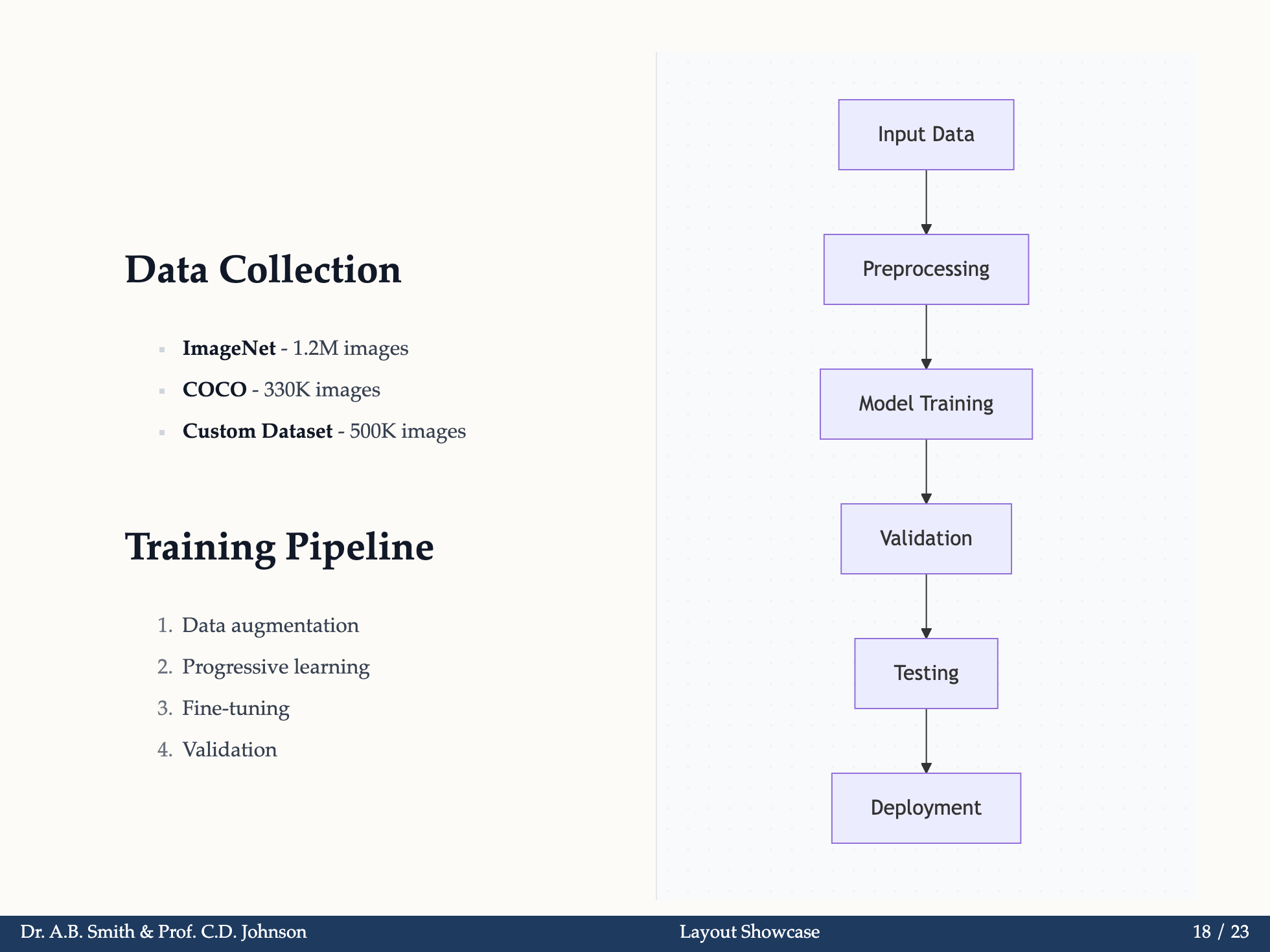
methodology - Research Methodology
Use for: Two-column layout for presenting research methods with diagrams
---
layout: methodology
ratio: "1:1"
title: Research Methodology
---
## Our Approach
1. Data Collection
2. Feature Extraction
3. Model Training
::right::
Props:
ratio: Column ratio (default: "1:1")title,subtitle: Header content
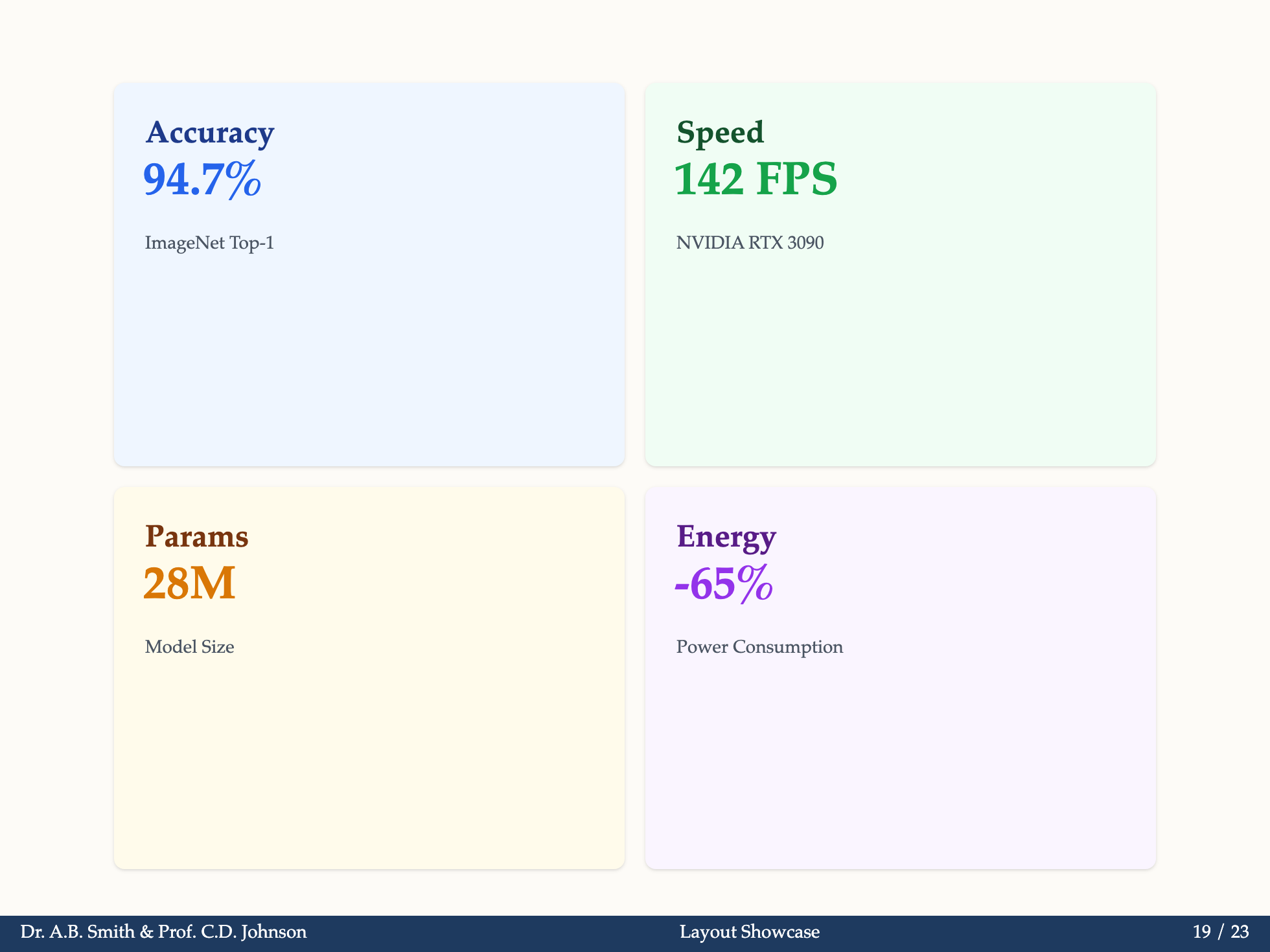
results - Results Dashboard
Use for: Grid layout for displaying multiple metrics or results
---
layout: results
cols: 2
title: Key Results
---

<div class="p-4 bg-white rounded shadow">
  <h3>Accuracy</h3>
  <h1>94.7%</h1>
</div>

<div class="p-4 bg-white rounded shadow">
  <h3>Speed</h3>
  <h1>2.3x</h1>
</div>
Props:
cols: Number of columns (default: 2)title,subtitle: Header content
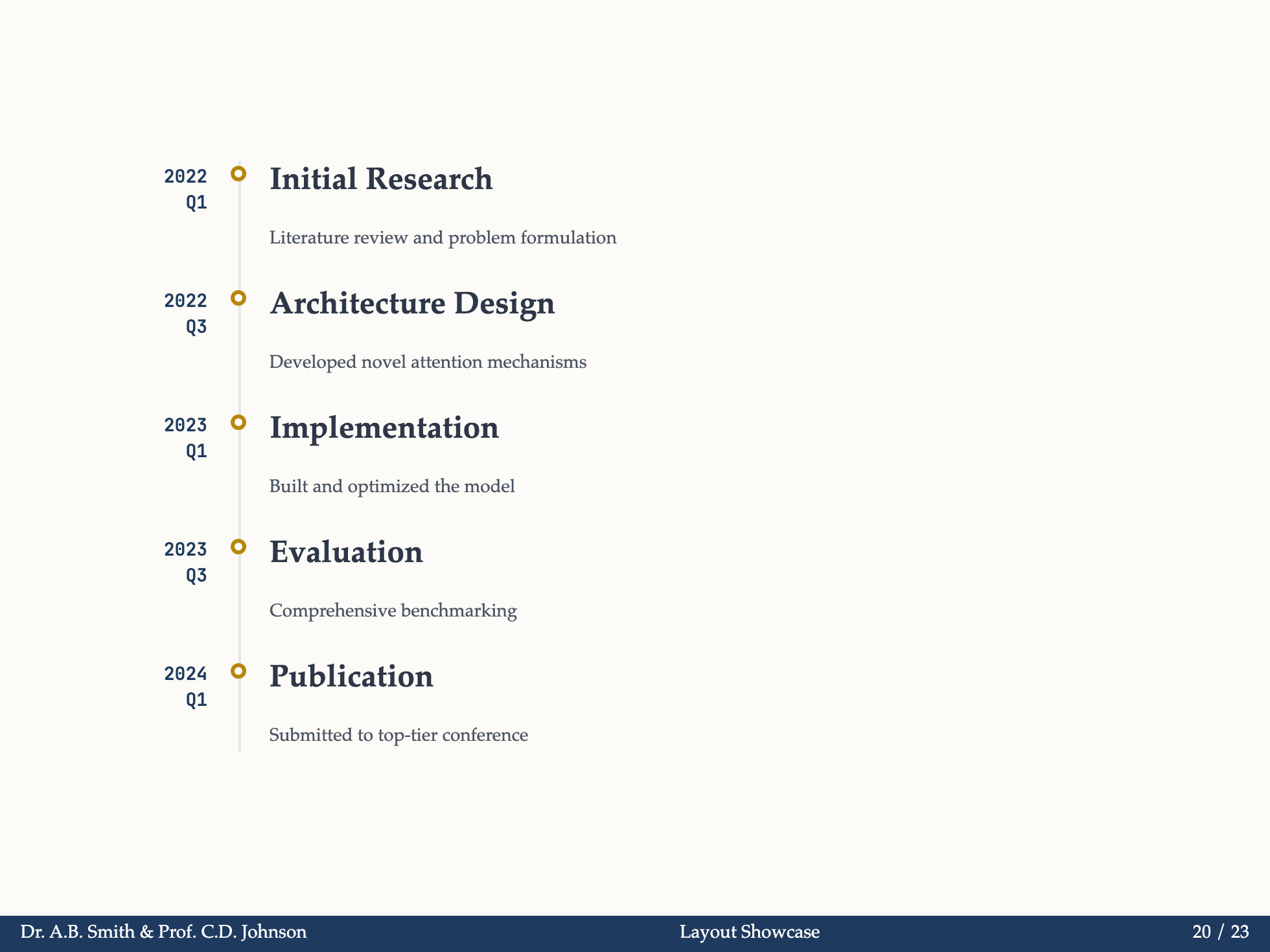
timeline - Research Timeline
Use for: Display research progress or historical events in a vertical timeline format
---
layout: timeline
title: Research Timeline
items:
  - year: "2020"
    title: Initial Research
    description: Began exploring the problem space
  - year: "2021"
    title: Methodology Development
    description: Developed core algorithms
  - year: "2022"
    title: Validation
    description: Conducted experiments
---
Props:
title: Optional title above the timelineitems: Array of timeline items withyear,title, anddescription
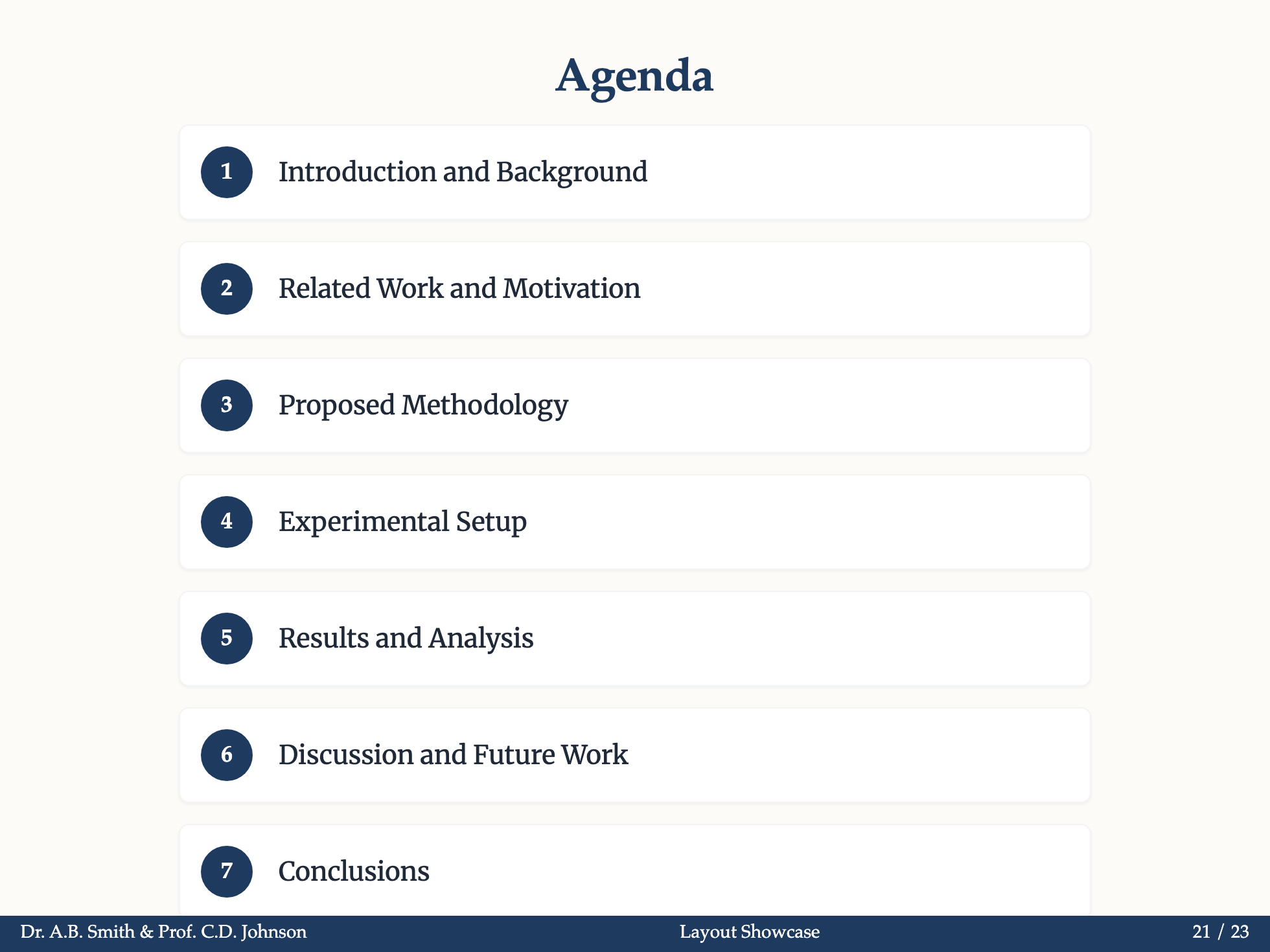
agenda - Agenda Overview
Use for: Present your presentation outline or meeting agenda

---
layout: agenda
title: Today's Agenda
items:
  - Introduction and Background
  - Methodology Overview
  - Experimental Results
  - Discussion and Future Work
---
Props:
title: Agenda title (default: "Agenda")items: Array of agenda item strings
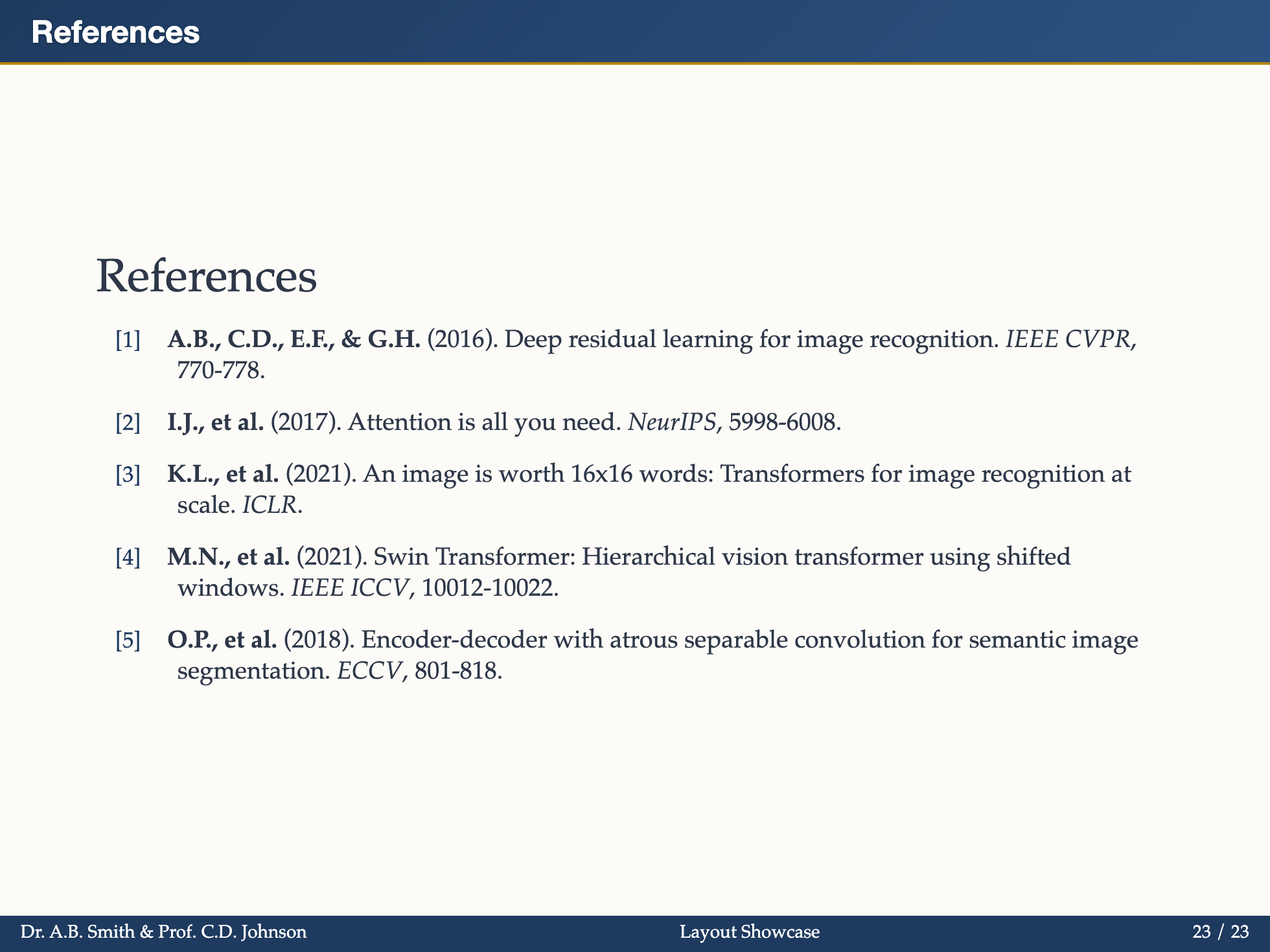
acknowledgments - Thank You & Credits
Use for: Display funding sources and collaborators
---
layout: acknowledgments
title: Acknowledgments
funders:
  - National Science Foundation
  - Department of Energy
collaborators:
  - MIT AI Lab
  - Stanford NLP Group
---

Special thanks to all contributors.
Props:
title: Section title (default: "Acknowledgments")funders: Array of funding organization namescollaborators: Array of collaborator names
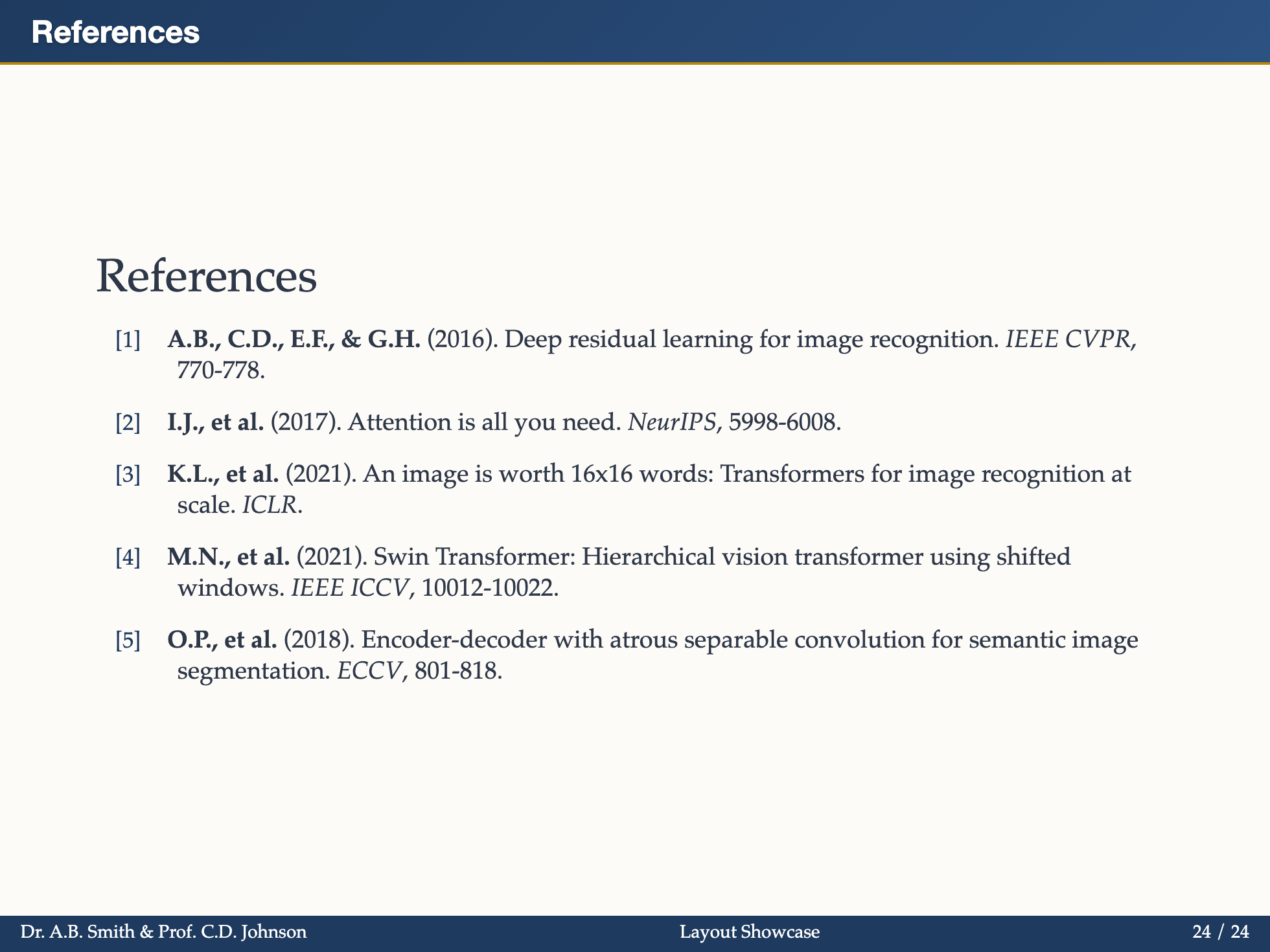
references - Bibliography
Use for: Display references in academic format. Automatically generates bibliography from BibTeX citations.
---
layout: references
---
For long reference lists, use pagination:
---
layout: references
perPage: 5
page: 1
---

---
layout: references
perPage: 5
page: 2
title: "References (continued)"
---
If you want the bibliography to appear at a specific point inside the slide, add [[bibliography]] manually at that exact position.
Manual references (without BibTeX):
---
layout: references
---

1. **Smith et al.** (2024). *Efficient Deep Learning*. Nature MI.

2. **Johnson & Williams** (2023). *Green AI*. ICML.

3. **Chen et al.** (2023). *Edge Computing*. NeurIPS.
Props:
page: Current page number (for pagination)perPage: Number of references per pagetitle: Custom title (default: "References" or "References (cont.)")
Features:
- Automatic numbered reference styling
- Clean academic typography
- Auto-adjusting font size based on content